

Runner’s Knee: Why It Happens and How to Build Your Way Back
By Dr. James Coomber, PT, DPT, CSCS, OCS, RRCA Certified Running Coach
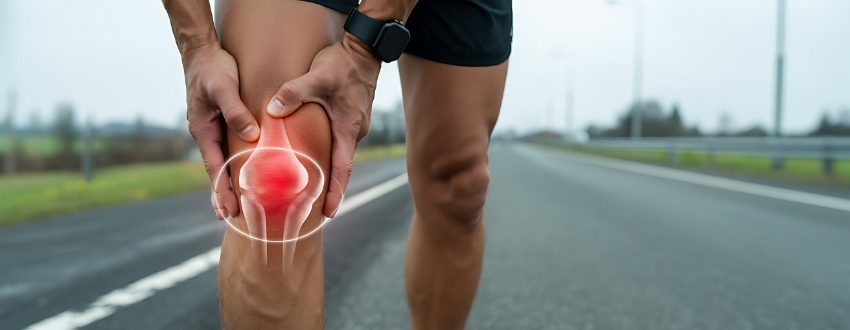
You’re a few miles into your Saturday long run—maybe on the boardwalk in Belmar, maybe looping through East Brunswick’s parks—and there it is. That dull ache creeping in just below your kneecap. Not sharp enough to stop you. Not quiet enough to ignore.
So you do what runners do. You push through, ice it at home, and hope it’s gone by Tuesday.
But it’s not gone by Tuesday. And now you’re wondering if you need to take a month off or just keep pushing through.
If this sounds familiar, you’re dealing with runner’s knee—and you’re far from alone.
What’s Actually Happening
Runner’s knee, or patellofemoral pain syndrome, is the most common injury among recreational runners. It doesn’t arrive with drama like a pulled hamstring. It builds quietly—a whisper of discomfort that becomes a constant companion.
Your kneecap sits in a groove on your thigh bone and glides with every bend and straighten of your leg. When tracking goes off or tissues get overloaded, irritation sets in.
But here’s what most runners don’t realize: running is essentially controlled falling. Each stride, you’re absorbing two to three times your body weight on a single leg, then rapidly redirecting that force to propel yourself forward. Your knee doesn’t fail in isolation—it fails when the system supporting it can’t handle the demands.
The Real Problem: Your Foundation
Think of your running body like a house. Most runners with persistent knee pain have been trying to fix the roof while ignoring cracks in the foundation.
That foundation is strength capacity—specifically in the muscles responsible for absorbing force when your foot hits the ground. Your quads, glutes, and calves act as shock absorbers during the landing phase of each stride. When they lack the baseline strength to handle those forces, the knee takes the hit.
Here’s where it gets interesting. As your speed increases, the demands on these absorption muscles increase dramatically. A leisurely recovery jog and a tempo run at goal pace require very different levels of strength. Many runners have enough capacity for easy miles but break down when intensity rises.
Building From the Ground Up
Recovery from runner’s knee—real, lasting recovery—follows a specific progression. Skip a level and you’re building on sand.
Level 1: Strength Capacity
Before anything else, you need raw strength in the muscles that control deceleration. This means loaded squats, step-downs, and single-leg work that builds tissue resilience. Not three sets of ten with a resistance band. Real strength work that actually challenges you.
Level 2: Power Development
Strength alone isn’t enough. Running happens fast—your foot is on the ground for a fraction of a second. You need the ability to produce force quickly. This is rate of force development, and it’s trained through power work: medicine ball throws, kettlebell swings, and explosive movements that teach your muscles to fire rapidly.
Level 3: Light Plyometrics to Heavy Plyometrics
Now we bridge the gap to running-specific demands. Starting with low-level hops and progressing to more aggressive bounding and depth jumps, plyometrics train your muscles and tendons to store and release energy like springs. The goal is shortening ground contact time while maintaining control during the absorption phase—exactly what efficient running requires.
Throughout: Reactive Stability
While you’re building this vertical progression, there’s a horizontal element that can’t be ignored. Your glute medius and deep abdominals keep you moving in a straight line, preventing energy leaks and lateral collapse. And just like strength and power, stability must become reactive—your body needs to stabilize automatically and instantaneously as speeds increase. Static planks don’t cut it. You need stability that holds up under dynamic, high-speed conditions.
Why Guessing Doesn’t Work
Here’s the problem with generic rehab protocols: they can’t tell you where your foundation is cracked.
Is it a strength deficit? A power deficit? A stability issue? Some combination? Without objective measurement, you’re guessing—and guessing leads to the frustrating cycle of feeling better, returning to running, and breaking down again.
This is why we built the Shore Stride Running Lab inside our East Brunswick and Lake Como clinics.
VALD force plate testing quantifies your strength and power with precision. We measure force production, asymmetries between legs, and rate of force development. Instead of assuming your left hip is weaker, we know exactly how much weaker and can track improvement over time.
Runeasi gait analysis captures what happens when you actually run—impact loading, ground contact time, pelvic stability, and dynamic symmetry. Your body behaves differently at mile four than it does on a treatment table. This technology shows us the truth.
When we combine these tools, the guesswork disappears. We see exactly which level of your foundation needs work and build a targeted progression to address it.
The Path Forward
Runner’s knee is solvable. Not by resting indefinitely or pushing through pain, but by systematically building the strength, power, and reactive stability your body needs to handle running demands.
At Mana Physical Therapy and the Shore Stride Running Lab, we work with runners through every phase—from objective assessment through return to full training. If you’re tired of the injury cycle and ready to build a foundation that lasts, we’re here to help.
Dr. James Coomber is the owner of Mana Physical Therapy, with locations in East Brunswick and Lake Como, New Jersey. A board-certified orthopedic clinical specialist and RRCA certified running coach, he founded the Shore Stride Running Lab to bring data-driven assessment to injured runners and those looking to optimize performance.